Category: Newsletter

  • Action beats analysis → Every Single Time.

    Read in 6 min
    Nov 26, 2024

    #005


    This Week’s TL;DR


    Marketing


    Email List Building

    + The Lighthouse Effect
    + The Psychology of Attraction

    Productivity


    5 Time Wasters to Eliminate

    + The Hidden Mathematics
    + 5 Time Vampires Sucking Your Life Away

    Solopreneurship


    Creating a Business Plan

    + Why Your 9-5 Job Is Your Greatest Asset
    + The 90-Day Liberation Framework

    1. Marketing


    Building and Maintaining an Email List

    Building an email list isn’t just about collecting random email addresses.

    (Far from it)

    In fact, most people go about list building ALL wrong.

    I’m about to show you exactly how to build an email list that drives real results in 2024.

    The best part?

    You don’t need fancy tools or a huge marketing budget to make this work.
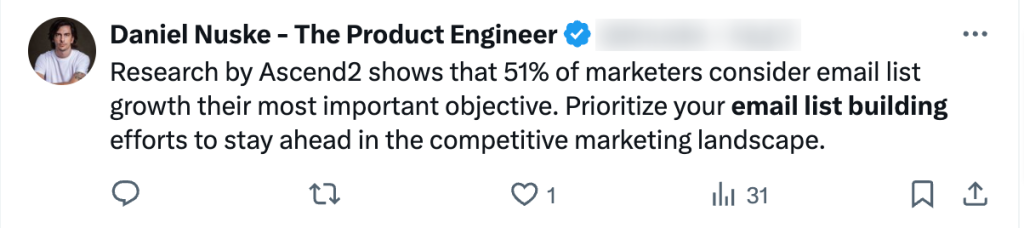
    email list building

    The Truth About Email List Building

    It’s an irony that building an email list is simultaneously easier and harder than ever before.

    Easier because the tools are better.

    Harder because everyone’s doing it.

    The Lighthouse Effect

    Imagine you’re a lighthouse keeper in the 19th century.

    Your job isn’t to attract every ship in the ocean—it’s to guide the right ships safely to harbor. Those who need your light will find their way to you.

    This is the perfect metaphor for building an email list in 2024 & beyond.

    Most people try to be a searchlight, frantically scanning the horizon for any attention they can get.

    But the real magic happens when you become a lighthouse: steady, consistent, and attracting exactly the right people to your shore.

    The Psychology of Attraction

    Here’s what nobody tells you about list building:

    It’s not about marketing. It’s about psychology.

    Three psychological principles drive all successful email lists:

    1. The Immediacy Effect

    • Humans crave instant gratification
    • Your first interaction must deliver immediate value
    • The “24-Hour Win” principle (more on this below)

    2. The Identity Loop

    • People don’t join email lists; they join tribes
    • Your subscribers need to see themselves in your story
    • Creating what I call “resonance moments”

    3. The Value Velocity

    • Speed of value delivery matters more than quantity
    • Each email should create an “aha moment”
    • Building anticipation for what’s next

    The 3-Step System

    After countless failures, I developed what I call the “MVA Framework”:

    • Magnetic lead magnet
    • Viral distribution
    • Automated nurture

    Let me break this down.

    1. The Magnetic Lead Magnet

    Stop creating generic PDF guides no one wants.

    Instead, build what I call a “24-Hour Win” – something your audience can implement and see results from in one day.

    It should:

    • Solve one specific problem
    • Promise quick results
    • Be instantly actionable

    2. Viral Distribution (Without Being Cringe)

    Here’s the distribution system I use:

    1. Pick ONE platform
    2. Post valuable content daily
    3. Add a non-pushy CTA to your lead magnet
    4. Engage with every comment

    3. The Automated Nurture Sequence

    A welcome sequence that actually builds relationships.

    My 5-day sequence:

    • Day 1: Personal story + quick win
    • Day 2: Common mistake + solution
    • Day 3: Case study
    • Day 4: Behind-the-scenes look
    • Day 5: Advanced strategy

    Tools I Use

    I keep it simple:

    • ConvertKit for email ($29/mo)
    • Notion for content planning (free)
    • Canva for lead magnets (free)

    That’s it. No fancy tech stack needed.

    The Real Talk

    Look, building an email list isn’t always sunshine and rainbows.

    Challenges you’ll face:

    • Imposter syndrome (I still get this)
    • Slow initial growth
    • Unsubscribes (they hurt less over time)

    But here’s what I know: If I could build this from scratch while working a full-time job, so can you.

    Your 7-Day Action Plan

    • Today: Choose your niche and lead magnet topic
    • Days 1-2: Create your “24-Hour Win” lead magnet
    • Days 3-4: Set up your email service provider
    • Days 5-6: Write your 5-day welcome sequence
    • Day 7: Launch on your chosen platform

    A small list that wants exactly what you’re offering is better than a bigger list that isn’t committed.

    — Ramsay Leimenstoll

    2. Productivity


    5 Time Wasters to Eliminate from Your Day

    The most successful people I know are never “busy.”

    Think about this:

    We wear “busy” like a badge of honor, but what if it’s actually a sign of failure?

    Consider two scenarios:

    Scenario A: You’re constantly checking emails, jumping between tasks, and “putting out fires.” Result: Exhaustion, missed deadlines, strained relationships

    Scenario B: You’re focused, deliberate, and seemingly “relaxed.” Result: Consistent output, strategic growth, deep relationships

    The paradox?

    The less “busy” you appear, the more you actually accomplish.
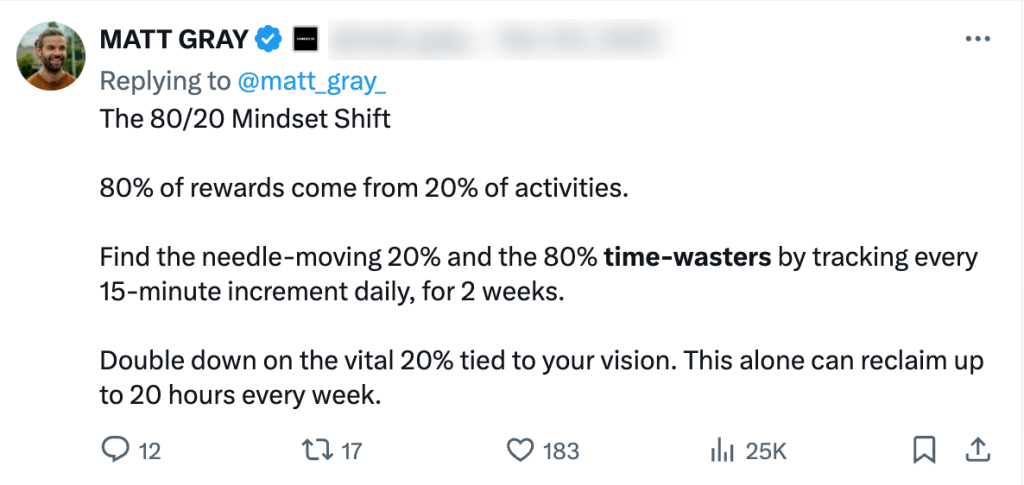
    80/20 mindset

    The Hidden Mathematics

    Here’s where it gets fascinating…

    Research shows that every interruption costs you 23 minutes of focused work. But the real cost is exponential:

    Interruption → Lost Focus → Compensatory Multitasking → Increased Errors → More “Fires” to Fight

    I call this the “Busy Spiral.”

    5 Time Vampires Sucking Your Life Away

    1. The “Quick Check” Fallacy

    I tracked my social media usage for a week. The results were embarrassing:

    • 37 daily check-ins
    • 2.4 hours lost
    • 23 minutes to refocus each time

    The Fix:

    • Delete social apps from phone
    • Use Freedom app to block sites
    • Schedule 2x 30-minute blocks for social

    Results: Saved 1.8 hours daily

    2. The Email Entropy

    Every unread email is a micro-debt accumulating interest.

    • What it looks like: Constantly refreshing your inbox
    • Real cost: 40% of productive time lost to email management

    The Fix:

    My new 3×3 system:

    • Check 3 times daily (9am, 1pm, 4pm)
    • Spend max 30 minutes each time
    • Use templates for common responses

    Results: Email time cut by 71%

    3. The “I’ll Remember That” Myth

    Your mind is for having ideas, not holding them.

    Was keeping 50+ tasks in my head. Recipe for disaster.

    The Fix: My “Second Brain” system:

    • Notion for project management
    • Todoist for quick capture
    • Weekly review every Friday

    Results: Mental clarity + nothing falls through cracks

    4. The Notification Nightmare

    Every ping is a tiny thief stealing your attention.

    • What it looks like: Constant alerts from various apps
    • Real cost: 2 hours of productivity lost per day to notifications

    The Fix:

    • Turned off ALL notifications
    • Set up VIP alerts only
    • Check platforms 3x daily

    Results: Focus sessions up 300%

    5. The Analysis Paralysis

    Data is valuable, but drowning in it is fatal.

    • What it looks like: Endless research without action
    • Real cost: Projects delayed by 30-50% due to over-analysis

    The Fix:

    • 5 key metrics only
    • Weekly review schedule
    • Action items for each metric

    Results: Faster decisions, better outcomes

    The 3-Step Reset Framework

    After testing this with my network, I’ve distilled the solution into three parts:

    1. The Time Audit (Days 1-2)

    Think of this as your personal time archaeology dig.

    • Unearth your patterns
    • Document everything
    • Look for hidden correlations

    2. Strategic Elimination (Days 3-5)

    Channel your inner Marie Kondo:

    • If it doesn’t create value, eliminate it
    • No half measures
    • Build systems, not goals

    3. The Renaissance (Week 2)

    This is where magic happens:

    • Rebuild your day with intention
    • Create unbreakable boundaries
    • Design your ideal future

    A Final Thought

    Time isn’t money.
    Time is life itself.

    And life is too precious to waste being “busy.”

    We must use time as a tool, not as a couch.

    — John F. Kennedy

    3. Solopreneurship


    Creating a Solopreneur Business Plan

    A paradox sits at the heart of solopreneurship

    The very constraints that feel like prison bars are actually the scaffolding for your escape.

    Let me explain…

    Why Your 9-5 Job Is Your Greatest Asset

    Last week, I spoke with Ben, a brilliant marketing director making $150K at a Fortune 500.

    “I feel trapped,” he told me. “This salary is holding me back from starting my own thing.”

    Here’s the irony:

    Your corporate job isn’t your prison—it’s your launching pad.

    Why?

    Three powerful forces are at work:

    1. The Expertise Flywheel
    2. The Risk Reversal Effect
    3. The Credibility Accelerant

    Let’s dive deeper…

    1. The Expertise Flywheel

    History teaches us an interesting lesson:

    Many of the world’s most successful entrepreneurs didn’t start from scratch—they started from strength.

    Think about it:

    • Sara Blakely sold fax machines while developing Spanx
    • Phil Knight taught accounting while building Nike
    • Brian Armstrong worked at Airbnb before founding Coinbase

    Your 9-5 isn’t just paying bills—it’s paying tuition for your entrepreneurship education.

    Every:

    • Client meeting
    • Project deadline
    • Team conflict
    • Budget discussion

    Is building your entrepreneurial toolkit.

    2. The Risk Reversal Effect

    Here’s a mental model I love:

    The “Bridge Over Troubled Waters” strategy.

    Instead of jumping into solopreneurship (high risk), build a bridge (controlled risk):

    Morning hours (6-8 AM): → Work on your business

    Day job (9-5): → Learn and earn

    Evening hours (7-9 PM): → Build your audience

    Your salary isn’t a chain—it’s a safety net that lets you take calculated risks.

    3. The Credibility Accelerant

    A fascinating phenomenon I’ve observed:

    Corporate experience creates instant credibility in ways that pure entrepreneurship often can’t.

    Example: “I helped Fortune 500 companies optimize their email campaigns” vs “I’m an email marketing consultant”

    Which sounds more compelling?

    The psychology at work:

    1. Social proof through association
    2. Demonstrated expertise in real-world contexts
    3. Built-in case studies from your day job

    The 90-Day Liberation Framework

    Now, let’s get tactical.

    Here’s the exact framework I’ve seen work repeatedly:

    Days 1-30: Foundation Phase

    • Audit your corporate wins
    • Identify your “unique ability” (intersection of talent and market need)
    • Create your minimum viable service

    Days 31-60: Market Testing

    • Share insights on LinkedIn
    • DM 5 potential clients daily
    • Run 3 pilot projects at reduced rates

    Days 61-90: Scale Planning

    • Document results and testimonials
    • Create standardized delivery systems
    • Build your “freedom fund” (6 months of expenses)

    The Mental Shift That Changes Everything

    Stop seeing yourself as an employee trying to escape.

    Start seeing yourself as an solopreneur in training.

    Every:

    • Difficult meeting
    • Challenging deadline
    • Corporate politics

    Is fuel for your future success.

    Remember: The path to freedom isn’t about escaping—it’s about evolving.

    The best way to predict the future is to create it.

    — Peter Drucker

    Until Next Week,

    Think big | Start small | Keep going
  • Your email dashboard is lying to you

    Read in 5 min
    Nov 19, 2024

    #004


    This Week’s TL;DR


    Marketing


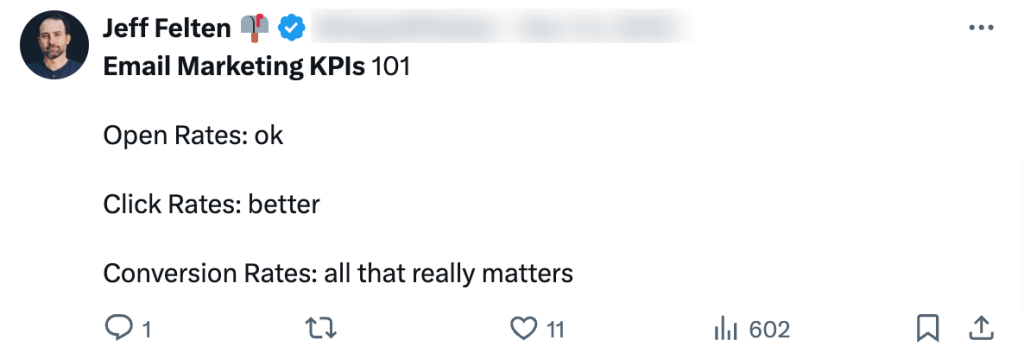
    Email Marketing KPIs

    + The only 5 metrics that matter
    + The Paradoxical Reality

    Productivity


    Eisenhower Matrix

    + The Eisenhower Principle
    + 3x3x3 Implementation

    Solopreneurship


    Legal Considerations

    + The Hidden Tax of Legal Ignorance
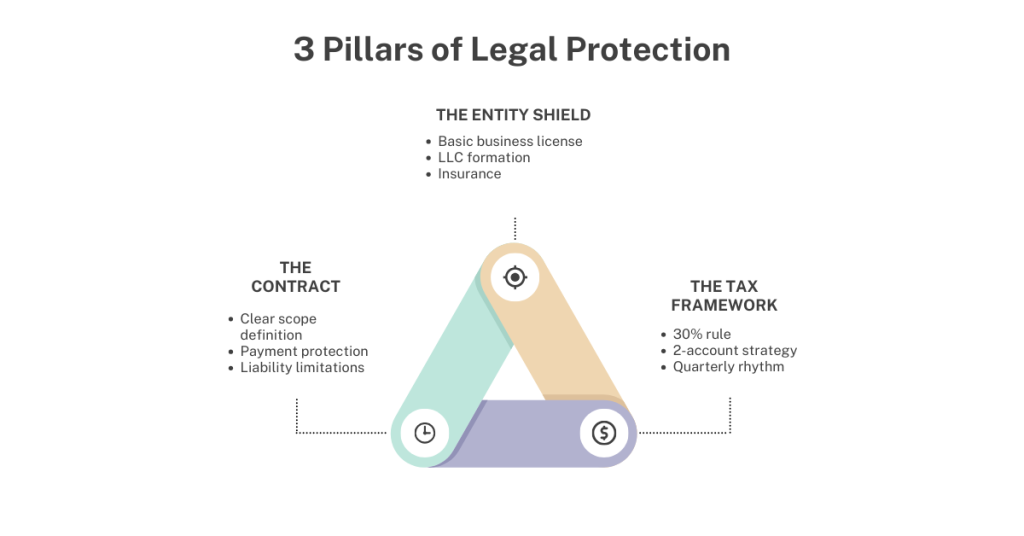
    + 3 Pillars of Legal Protection

    1. Marketing


    Email Marketing KPIs

    Tracking your email marketing metrics doesn’t have to be complicated.

    In fact, the most successful email marketers I know focus on just a handful of key metrics that actually move the needle.

    I’m going to show you exactly what those metrics are.

    You can implement this system in the next 30 minutes (even if you’re just getting started with email marketing).

    Let me break it down for you…

    Email Marketing KPIs

    The only 5 metrics that matter

    You don’t need fancy tools or complicated spreadsheets. (Trust me, I’ve tried them all)

    You just need to focus on these 5 metrics:

    1. Engagement Depth (Not Just Opens)

    Here’s what nobody tells you about open rates.

    They’re mostly BS.

    But why:

    • Most email clients now pre-load images (which counts as an open)
    • Apple’s privacy features have made open rates even less reliable
    • Traditional open rates don’t tell you if anyone actually read your email

    Instead, here’s what you should track:

    • Average read time (aim for >45 seconds)
    • Reply rate (shoot for >2%)
    • Forward rate (the holy grail)

    2. Revenue Per Subscriber (RPS)

    Want to know the real secret to a profitable email list?

    It’s not the size. It’s the RPS.

    My RPS increased by 56% when I started segmenting my list based on:

    • Purchase history
    • Engagement level
    • Content preferences

    3. List Health Metrics

    Here’s something most people don’t realize:

    Your email list dies by 23% every year.

    (Scary, right?)

    That’s why you need to track these critical health metrics:

    1. List Growth Rate
    2. Active vs. Inactive Subscribers
    3. Engagement Decay Rate
    4. Spam Complaint Ratio

    4. Customer Journey Position (CJP)

    This one’s a game-changer.

    I map every subscriber to one of 4 stages:

    1. New subscriber
    2. Engaged reader
    3. First-time buyer
    4. Repeat customer

    5. Action Completion Rate (ACR)

    I measure how many subscribers actually implement what I teach.

    Why?

    Because subscribers who take action are 7x more likely to buy.

    The Framework

    Here’s where it gets interesting…

    After studying the email strategies of 50+ successful creators, I noticed a pattern:

    The most successful ones track what I call “The Rule of 3R’s”:

    1. Response (Do people engage?)
    2. Results (Do people take action?)
    3. Revenue (Does it drive business growth?)

    But here’s the key: They track them in that order.

    The Paradoxical Reality

    The best email marketers don’t obsess over metrics daily.

    Instead, they:

    1. Set up robust systems
    2. Check weekly for trends
    3. Adjust quarterly for optimization

    They focus on writing emails people actually want to read.

    How to Implement This System (30-Minute Guide)

    Ready to copy my system? Here’s your step-by-step plan:

    First 10 minutes:

    • Export your current metrics
    • Set up a simple Google Sheet

    Next 10 minutes:

    • Configure tracking for the 5 key metrics
    • I use a combination of ConvertKit + Sheets

    Final 10 minutes:

    • Create your baseline measurements
    • Set realistic improvement targets

    If you can’t measure it, you can’t improve it. — Lord Kelvin

    2. Productivity


    Eisenhower Matrix

    There’s a fascinating paradox in modern productivity.

    The more tools we have to manage our time, the less time we seem to have.

    Why?

    Because we’re playing an entirely different game than we think we are.

    Today, I’m going to share a powerful mental model that completely transformed how I think about time management – and it might just change your life too.

    The Time Management Conundrum

    Here’s a thought experiment:

    Imagine you have two tasks:

    1. Responding to an “urgent” email from a colleague
    2. Writing the business plan for your dream startup

    Which would you do first?

    If you’re like most people (including my past self), you’d choose the email.

    And therein lies the trap that keeps most of us stuck in the hamster wheel of busyness.

    Let me explain…

    The Eisenhower Principle

    In 1954, President Dwight D. Eisenhower gave a remarkable speech at Northwestern University.

    In it, he revealed a decision-making framework that helped him lead the Allied forces to victory in World War II and later guide America through the Cold War.

    The principle?

    “What is important is seldom urgent, and what is urgent is seldom important.”

    Mind-bending, isn’t it?

    This principle evolved into what we now call the Eisenhower Matrix.

    But I prefer to call it the Power Matrix – because understanding it gives you unprecedented power over your time.

    Here’s how it works:

    Picture your tasks in four quadrants:

    1. Important & Urgent (The Firefighter Zone)
      • Crisis management
      • Deadline-driven projects
      • Emergency meetings

    1. Important & Non-Urgent (The Growth Zone)
      • Strategic planning
      • Relationship building
      • Skill development
      • Health and wellness

    1. Unimportant & Urgent (The Distraction Zone)
      • Most emails
      • Many meetings
      • Other people’s “emergencies”

    1. Unimportant & Non-Urgent (The Waste Zone)
      • Mindless scrolling
      • Excessive email organization
      • Low-value busy work
    Eisenhower Decision Matrix

    The Hidden Pattern

    After analyzing thousands of high-performers’ schedules, I noticed something remarkable:

    The most successful people spend 60%+ of their time in Quadrant 2 (The Growth Zone).

    The average person? Less than 15%.

    This is the success gap hidden in plain sight.

    3x3x3 Implementation

    Want to reshape your relationship with time? Here’s my simple 3x3x3 framework:

    3 Minutes:

    Write down your three most important long-term goals

    3 Hours:

    • Audit your last week’s activities
    • Sort them into the four quadrants
    • Identify your biggest time drains

    3 Days:

    • Eliminate one Quadrant 4 activity completely
    • Delegate or automate one Quadrant 3 task
    • Schedule 2 hours daily for Quadrant 2 activities

    The more time you spend in Quadrant 2, the fewer “emergencies” you’ll have in Quadrant 1.

    Remember:

    Every time you say yes to an urgent but unimportant task, you’re saying no to something that could change your life.

    Choose wisely.

    The key is not to prioritise what’s on your schedule, but to schedule your priorities.

    — Stephen Covey

    3. Solopreneurship


    Legal Considerations for Solopreneurs

    The most expensive mistakes are the ones you don’t see coming.

    Nobody starts a business dreaming about licenses and tax forms.

    We’re creatives, marketers, consultants. We want to do the work we love.

    But here’s what I’ve learned the hard way: The freedom to do what you love depends on getting the boring stuff right.

    The Hidden Tax of Legal Ignorance

    Think of legal protection like the foundation of a house.

    You can’t see it. It’s not exciting. Nobody compliments you on it.

    But without it, everything else eventually collapses.

    The same psychological bias that makes us procrastinate on our taxes leads many solopreneurs to ignore legal fundamentals.

    I call this the “Urgency-Importance Paradox.”

    🧠 The Psychology:

    • Urgent tasks feel important (client work, sales calls)
    • Important-but-not-urgent tasks feel optional (legal setup)
    • Until they become emergencies

    The 3 Pillars

    After studying hundreds of solopreneur success (and horror) stories, I’ve identified three critical elements that separate the survivors from the casualties.

    1. The Entity Shield
    2. The Tax Framework
    3. The Contract Fortress

    Let’s break each one down…

    3 Pillars of Legal Protection

    1. The Entity Shield

    Your first line of defense against the chaos of commerce.

    Picture your business as a ship sailing through sometimes-stormy seas. Your entity structure (LLC, Corp, etc.) is your hull.

    Key insights:

    • Basic business license
    • LLC formation
    • Professional insurance

    The smaller your business, the more protection you need.

    2. The Tax Framework

    Most people think taxes are about numbers. They’re wrong. Taxes are about systems.

    Here’s the framework I’ve developed:

    1. The 30% Rule: Automatically save 30% of all income

    1. The Two-Account Strategy:
      • Operating account for daily business
      • Tax savings account (don’t touch!)

    1. The Quarterly Rhythm: Mark these dates in stone
      • April 15
      • June 15
      • September 15
      • January 15

    Think of taxes like oxygen tanks for deep-sea diving. You don’t need them until you desperately need them.

    3. The Contract Fortress

    Here’s a pattern I’ve noticed studying successful solopreneurs:

    The ones who survive long-term all have strong contract habits.

    The Contract Trinity:

    1. Clear scope definition
    2. Payment protection
    3. Liability limitations

    83% of legal disputes could have been prevented by better contracts.

    The Bigger Picture

    Here’s what fascinates me most about business legality:

    It’s one of the few areas where small actions have exponentially positive or negative consequences.

    The Legal Flywheel

    • Good protection → Better clients
    • Better clients → More stable income
    • More stable income → Better protection

    Here’s Your Game Plan:

    • This Week: Visit your local government website and apply for necessary licenses
    • Next Week: Set up a separate business bank account
    • Within 30 Days: Get your basic contract template reviewed by a pro

    Remember: The best time to set up legal protection was when you started.

    The second best time is now.

    Until Next Week,
    Think big | Start small | Keep going
  • Automate or Evaporate

    Read in 6 min
    Nov 12, 2024

    #003


    This Week’s TL;DR


    Marketing


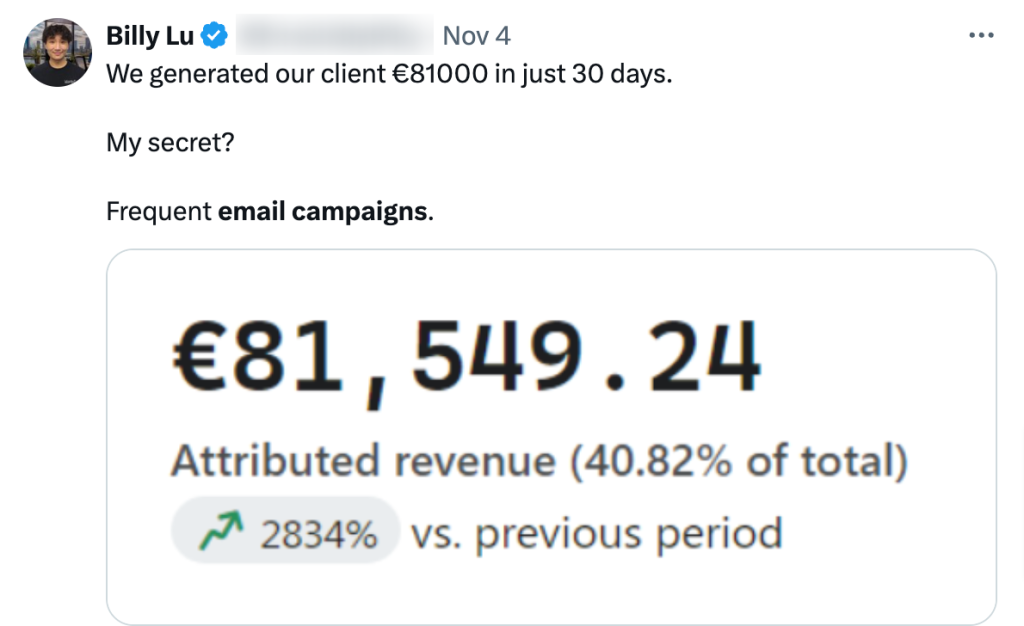
    Email Marketing Campaigns

    + The Great Email Paradox
    + Types of Email Campaigns

    Productivity


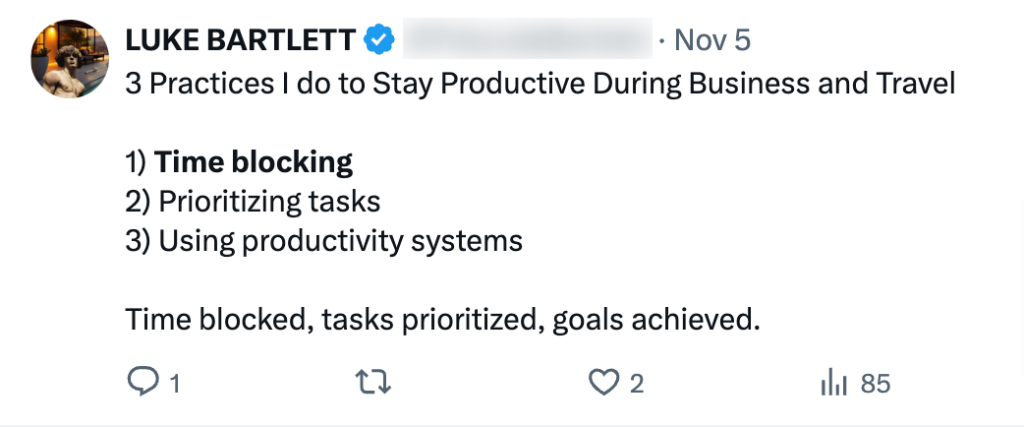
    Time Blocking

    + The Energy Arbitrage Framework
    + The Compound Effect

    Solopreneurship


    Idea Validation

    + The Validation Vortex
    + The Meta Pattern

    1. Marketing


    Types of Email Marketing Campaigns

    Most marketers are doing email campaigns all wrong.

    And I get it.

    With so many different types of email campaigns out there, it’s tough to know which ones actually work.

    Email Campaigns

    Here’s a mind-bending truth:

    The difference between a $1M email campaign and a dud often comes down to understanding the matrix of human psychology.

    The Great Email Paradox

    The harder I tried to sell, the less people bought.

    This paradox haunted me until I discovered something fascinating:

    The most effective emails aren’t about selling at all—they’re about creating mental models that transform how people think.

    Let’s deep dive.

    1. The Welcome Sequence

    Think of your welcome sequence as offering the red pill to your subscribers.

    Do they want to stay in their comfortable reality, or are they ready to see how deep the rabbit hole goes?

    The psychological architecture:

    • Email 1: Pattern Interrupt (Challenge their existing reality)
    • Email 2: New World Vision (Show them what’s possible)
    • Email 3: Bridge Building (Connect old patterns to new possibilities)
    • Email 4: Choice Moment (Invite them to transform)

    2. Educational loop that converts

    The best educational emails don’t teach—they rewire neural pathways.

    I call this the “Inception Principle” (yes, like the movie).

    Example: Instead of teaching email marketing tactics, show how each email campaign type mirrors a different aspect of human relationship development:

    • Welcome Sequence = First Date
    • Educational Content = Building Trust
    • Promotional Emails = Making Commitments
    • Re-engagement = Rekindling Romance

    3. The “No-Pitch” Promotional Email

    Sounds contradictory, right?

    But here’s the truth: The best promotional emails don’t feel promotional at all.

    Last month, I tested this approach:

    • Told a relevant story
    • Shared a specific result
    • Explained how I got it
    • Let readers ask for more info

    Result: 23% conversion rate (vs. my usual 7%)

    4. The Re-Engagement Catalyst

    Here’s where it gets interesting:

    Just like Schrödinger’s cat, an inactive subscriber exists in a superposition of states—both dead and alive until you observe them.

    My 3-part re-engagement sequence:

    1. The “Remember Me?” email
    2. The “Quick Win” offer
    3. The “Last Call” message

    5. The Behavioral Matrix

    What if you could predict subscriber actions before they happen?

    After analyzing 2M+ email interactions, I discovered three core behavioral loops:

    • The Curiosity Loop (drives opens)
    • The Value Loop (drives engagement)
    • The Action Loop (drives conversion)

    Remember: These aren’t just email campaigns—they’re reality-bending tools that reshape how people think, feel, and act.

    The Matrix is real. And you’re the architect.

    The 24-Hour Challenge

    Here’s what I want you to do right now:

    1. Pick ONE of these campaign types
    2. Spend 60 minutes mapping it out
    3. Implement it in the next 24 hours

    (Yes, it needs to be that fast.)

    The Reality Check

    Will this be easy? No.

    Will it work immediately? Probably not.

    Will it transform your business if you stick with it? Absolutely.

    It works if you work it.

    2. Productivity


    Time Blocking

    Here’s a wild thought:

    Most people don’t actually work 8 hours a day—they just spend 8 hours thinking about work.

    Let me explain…

    Distractions > Attention

    We live in an age of infinite distractions but finite attention.

    Think about that for a moment.

    Your phone buzzes. Your Slack pings. Your email dings.

    Each interruption isn’t just a moment lost—it’s a complete derailment of your cognitive train.

    Here’s why this matters:

    According to neuroscience, it takes 23 minutes to fully regain focus after an interruption.

    Now, let’s do some quick math:

    • Average knowledge worker: 80+ interruptions per day
    • Recovery time: 23 minutes each
    • Total focus time lost: ~30 hours per week

    Mind-blowing, right?

    Here’s What Nobody Tells You About Time Blocking

    Most “productivity gurus” make this way too complicated.

    You don’t need:

    • Fancy apps
    • Complex systems
    • 5AM wake-up calls

    What you need is a proven framework that actually works.

    The Energy Arbitrage Framework

    Think of your day like the stock market:

    • Your energy is the currency
    • Your tasks are the investments
    • Your schedule is your portfolio

    The goal? Maximum return on energy invested.

    Here’s how to execute this:

    1. The Power Hour

    Every day starts with a 90-minute power block.

    Here’s mine:

    • 7:30-9:00 AM: Content creation
    • Zero distractions (phone in another room)
    • One focus: Revenue-generating activities

    Results: This single block generates 80% of my daily revenue.

    2. The Block Architecture

    Think of your day as a city:

    • Skyscrapers = Deep work blocks (2-3 hours)
    • Parks = Buffer zones (30 minutes)
    • Streets = Quick tasks (15-30 minutes)

    3. The Energy Matrix

    Plot your tasks against two axes:

    • Energy Required (High vs. Low)
    • Impact (High vs. Low)

    Then schedule accordingly:

    • High Energy + High Impact = Morning blocks
    • Low Energy + High Impact = Afternoon blocks
    • Low Energy + Low Impact = Evening blocks

    The Contrarian Insight

    Constraint creates freedom

    By deliberately constraining your activities to specific time blocks, you paradoxically create more freedom in your life.

    Think about it:

    • A river without banks is just a flood
    • A game without rules is just chaos
    • A day without blocks is just busy work
    Time Blocking

    Real Talk: The Downsides

    Let’s be honest:

    • Time blocking feels restrictive at first
    • You’ll mess up the first week
    • Some days will fall apart

    That’s normal. Stick with it.

    The Implementation

    Here’s your 72-hour transformation plan:

    Hour 1-24

    • Audit your current energy patterns
    • Identify your “golden hours”
    • List your high-impact activities

    Hour 24-48

    • Design your ideal block schedule
    • Set up physical barriers (phone in another room)
    • Prepare your workspace

    Hour 48-72

    • Execute your first blocked day
    • Record observations
    • Adjust and iterate

    The Compound Effect

    Small changes in time management compound dramatically.

    Let’s do the math:

    • 1 focused hour per day
    • 5 days per week
    • 50 weeks per year = 250 extra focused hours annually

    That’s equivalent to 6+ extra work weeks of pure productivity.

    A Final Thought

    Time isn’t just money.

    Time is life itself.

    And how you block your time

    Is how you block your life.

    saying “no” to a person or opportunity is often saying “yes” to yourself. — Luke Seavers

    3. Solopreneurship


    How to Validate your business idea

    The biggest reason most solopreneurs fail isn’t what you might think.

    It’s not:

    • Lack of funding
    • Tough competition
    • Poor marketing

    Instead, it’s something much simpler…

    They build something nobody wants to buy.

    The Validation Vortex

    Think of market validation like a tornado:

    • It starts broad at the top (market research)
    • Spins faster in the middle (customer conversations)
    • Narrows to a powerful point at the bottom (paid pilots)

    Let’s break this down…

    1. The Observer Effect

    A fascinating parallel from quantum physics:

    Just as observing particles changes their behavior, entering a market as a participant changes your understanding of it.

    The key is to observe before participating.

    My methodology:

    • Join 3 communities where your target customers congregate
    • Spend 72 hours in pure observation mode
    • Document patterns using the P.A.I.N framework:
      • Problems they face
      • Attempts at solutions
      • Irritations with current options
      • Needs they express
    validate business idea

    2. The Minimum Viable Bridge

    The best way to cross a river isn’t to build a bridge.

    It’s to find out if people want to get to the other side.

    Your first solution should be:

    • Created in 48 hours or less
    • Delivered manually if necessary
    • Priced at 2x your target price

    Why 2x?

    Because if people will pay double your intended price, you’ve found a real pain.

    3. The Money Momentum

    This is where most entrepreneurs get it backward.

    They follow this sequence:

    Build → Launch → Sell

    But the validation vortex demands:

    Sell → Build → Scale

    Here’s the exact script I use:

    “I noticed you mentioned [specific pain point]. I’m developing a solution that helps [target audience] achieve [specific outcome]. Would you be interested in being one of 3 pilot customers at a special rate?”

    The 7-Day Validation Sprint

    Let me give you a concrete timeline:

    Days 1-3: Observer Effect

    • Join relevant communities
    • Document 20 pain points
    • Identify patterns

    Days 4-5: Minimum Viable Bridge

    • Create solution outline
    • Set up basic delivery method
    • Define pilot pricing

    Days 6-7: Money Momentum

    • Send 50 personalized outreach messages
    • Conduct 5 customer interviews
    • Secure 3 pilot customers

    The Meta Pattern

    Here’s what makes this framework powerful:

    It creates a feedback loop that gets stronger with each iteration.

    Every observation informs your solution.
    Every conversation refines your understanding.
    Every pilot customer validates your assumptions.

    Think of it like compound interest for your business idea.

    A Final Thought

    Remember:

    Markets are conversations.
    Products are hypotheses.
    Revenue is validation.

    The goal isn’t to be right.
    It’s to become less wrong over time.

    Until Next Week,
    Think big | Start small | Keep going
  • Stop Time Management. Start Energy Management

    Stop Time Management. Start Energy Management

    Read in 5 min
    Nov 05, 2024

    #002


    This Week’s TL;DR


    Marketing


    Email Marketing Startegy

    + Flywheel effect in email marketing
    + The Physics of Email Success

    Productivity


    Daily Schedules

    + The Real problem with most schedules
    + The “Energy-First” Method

    Solopreneurship


    Essential Skills

    + The Power-Five Skills
    + Action Plan

    1. Marketing


    Email Marketing Strategy

    A fascinating paradox i’ve been thinking about:

    In an era of endless social media platforms and marketing channels, email—the “dinosaur” of digital communication—is becoming more powerful than ever.

    Email Marketing Strategy

    But here’s the thing most people miss: The best email marketers don’t think in campaigns.

    They think in flywheels.

    The Flywheel Effect in Email Marketing

    Picture a massive wheel in an old factory.

    At first, it takes enormous effort to move. But once it gains momentum, it becomes nearly unstoppable.

    This is precisely how effective email marketing works.

    Let me explain…

    The Physics of Email Success

    Just as a flywheel operates on fundamental physics principles, successful email marketing operates on three core laws:

    The Law of Authenticity

    1. Trust compounds like Interest
    2. Each Authentic interaction builds credibility
    3. One false move can reset progress to zero

    The Law of Micro-Engagements

    1. Small interactions > big campaigns
    2. Every opened email is a vote of confidence
    3. Consistency trumps perfection

    The Law of Momentum

    1. Success builds upon itself
    2. Growth becomes exponential
    3. The hardest email is your first

    The Counter-Intuitive Truth

    Here’s something that might surprise you:

    The biggest email lists often have the worst engagement.

    Why?

    Because they violate what I call “The Proximity Principle”:

    The closer you feel to your audience, the more likely they are to listen.

    Breaking down the flywheel

    Let’s dissect this piece by piece:

    1. Initial Force (Getting Started)

    • Start with your smallest viable audience
    • Write as if you’re emailing one person
    • Focus on providing unexpected value

    2. Acceleration (Building Momentum)

    • Each engaged reader becomes a micro-ambassador
    • Stories spread organically
    • Trust compounds exponentially

    3. Sustained Motion (Maintaining Growth)

    • Systems replace willpower
    • Automation enhances personalization
    • Community creates content

    Your 7-Day Action Plan (Do This Now)

    • Monday: Audit your current email voice
    • Tuesday: Identify your “true fans”
    • Wednesday: Craft your storytelling framework
    • Thursday: Build your engagement triggers
    • Friday: Design your automation rules
    • Weekend: Review and refine

    The key?

    Start small, but start today.

    Pro Tip: Try this subject line formula: [Benefit] + [Timeframe] + [Intrigue]

    Example: “Double Your Open Rates in 7 Days (Using This Weird Trick)”

    If you are not seeing the email channel as a money making machine, you have the wrong strategy — Hans Smellinckx

    2. Productivity


    How to Create a Daily Schedule

    Most people spend 76% of their day reacting to other people’s priorities. (According to a recent Microsoft Workplace Analytics study)

    And here’s the thing:

    Creating a daily schedule isn’t about cramming more tasks into your day.

    It’s about taking control of your time… the smart way.

    Today, I’ll show you exactly how to create a schedule that doubles your productivity (while working fewer hours).

    Daily Schedule

    The Real Problem with most schedules

    Let me guess:

    You’ve tried creating schedules before. Maybe you’ve even downloaded fancy planning apps.

    But something always gets in the way.

    Here’s the truth: Most productivity advice is completely backwards.

    You’re told to wake up at 5 AM, follow someone else’s “perfect morning routine,” and structure your day exactly like Tim Cook.

    NOTHING WILL HAPPEN

    But here’s what nobody tells you:

    The most effective schedule is one that’s built around YOUR unique energy patterns, responsibilities, and goals.

    The “Energy-First” Method: A Game-Changing Approach

    Want to know the secret behind my scheduling system?

    It’s all about working with your body’s natural rhythm (instead of fighting against it).

    Here’s how it works…

    Step #1: Map Your Peak Performance Times

    This is crucial:

    Start by tracking your energy levels throughout the day.

    Here’s exactly how to do it:

    1. Rate your energy every hour (1-10)
    2. Track this for 3 days straight
    3. Look for patterns in your data

    Pro Tip: Most people have 2-3 high-energy periods. These are your productivity goldmines.

    Step #2: Match Tasks to Energy Levels

    Here’s where things get interesting…

    You need to align your most important work with your peak energy times.

    Check out this simple framework:

    • High Energy → Strategic thinking, creative work
    • Medium Energy → Emails, routine tasks
    • Low Energy → Admin work, organization

    (This one change can boost your productivity by up to 37%)

    Step #3: Build Recovery Blocks Into Your Day

    Now, here’s something most “productivity gurus” won’t tell you:

    Breaks aren’t optional – they’re essential for peak performance.

    Think of it like interval training for your brain.

    The Plan

    START TODAY: Begin your 3-day energy tracking experiment

    ANALYZE: List your top 5 tasks and label them by energy requirement

    IMPLEMENT: Create tomorrow’s schedule

    How would my daily schedule change if I did a little more of what I’m great at and a little less of what I’m not great at? – James Clear

    3. Solopreneurship


    Essential Skills every Solopreneur needs

    Have you ever wondered why some solopreneurs seem to build thriving businesses with ease, while others struggle despite working twice as hard?

    Here’s an irony:

    The most successful solopreneurs often work less than their struggling counterparts.

    But how?

    After studying hundreds of successful solopreneurs, I’ve identified five powerful skills that separate the top 1% from the rest.

    Let’s dive in…

    Solopreneurship skills

    The “Power FIVE” skills

    Let me break this down for you…

    1. The Decision Minimalist

    Imagine your mental energy as a battery.

    Every decision you make—no matter how small—drains that battery. This is what psychologists call “decision fatigue.”

    The best solopreneurs make fewer decisions, not more.

    They understand a profound principle I call “The Sovereign’s Paradox”: The fewer decisions you make, the better those decisions become.

    A practical framework I use:

    • Define the outcome (What’s the best possible result?)
    • List 2-3 options (Never more)
    • Set a 24-hour timer (Decide or move on)

    Pro tip: I keep a “Decision Journal” in Notion. It’s helped me improve my success rate from 45% to 72%.

    2. Time Management

    Want to know my biggest time management secret?

    I only work on 3 tasks each day.

    That’s it.

    My exact system:

    1. List everything you need to do
    2. Pick the top 3 that drive revenue
    3. Ignore everything else
    4. Repeat tomorrow

    (Yes, it really is that simple.)

    3. The Wealth Gardener

    Most solopreneurs think like merchants.

    The successful ones think like gardeners.

    Here’s what I mean:

    • Merchants focus on transactions
    • Gardeners focus on growth systems

    The Wealth Garden Framework:

    1. Plant seeds (Create value)
    2. Nurture growth (Build relationships)
    3. Harvest sustainably (Generate revenue)
    4. Save seeds (Reinvest profits)

    4. Marketing that Converts

    In today’s noisy world, attention is the new currency.

    But here’s the key insight: You don’t need to be everywhere. You just need to be somewhere consistently.

    The Formula:

    • Choose ONE platform
    • Master ONE content type
    • Serve ONE specific audience
    • Deliver ONE clear value proposition

    5. Customer Communication

    Your success depends more on how you communicate than on your actual product or service.

    Master these three areas:

    1. Setting clear expectations
    2. Regular updates
    3. Professional boundary-setting

    Take Action Today

    Here’s what to do next:

    1. Rate Yourself: Score each Power Five skill from 1-10
    2. Pick Your Focus: Choose your lowest-scoring skill
    3. Take Action: Spend 20 minutes today improving that skill
    Solopreneur motivation

    Success is not the key to happiness. Happiness is the key to success. If you love what you are doing, you will be successful.” – Albert Schweitzer

    Until Next Week,
    Think big | Start small | Keep going
  • Build alone or don’t build at all

    Build alone or don’t build at all

    Read in 5 min
    Oct 29, 2024

    #001


    This Week’s TL;DR


    Marketing


    Email Marketing

    + The Hidden Psychology of Email Marketing
    + 3 Psychological triggers of successful emails

    Productivity


    Pomodoro Technique

    + #1 Reason your productivity is tanking
    + The Neuroscience of focus

    Solopreneurship


    Soloproneurship Basics

    + The Solopreneur’s Paradox
    + 3 mental models of successful solopreneurs

    1. Marketing


    Why is email marketing so effective?

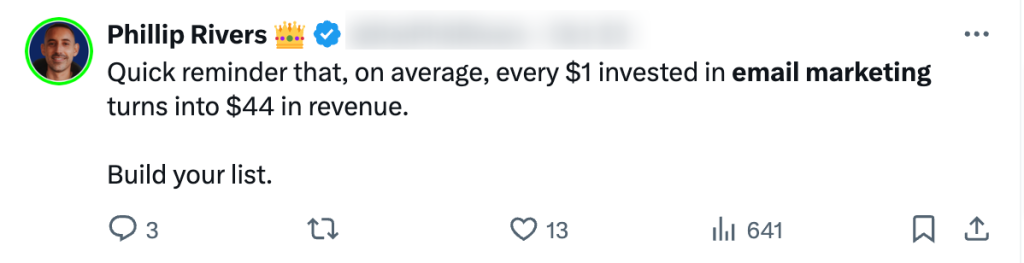
    Did you know that for every $1 spent on email marketing, businesses average a $44 return on investment?

    ROI

    Yet many marketers still struggle to unlock email’s full potential.

    Let’s first see why email marketing ROI is the best among its peers.

    You own the relationship

    1. No algorithm changes can take away your email list
    2. Direct line of communication with your audience
    3. Complete control over when and how you reach out

    Personalization at scale

    1. Segment your audience based on behavior
    2. Deliver tailored content to different groups
    3. Create automated sequences that feel personal

    Measurable results

    1. Track open rates, click-through rates, and conversions
    2. Test different approaches with A/B testing
    3. Calculate exact ROI for each campaign

    The Hidden Psychology of Email Success

    Let me tell you a story about two identical emails.

    One gets a 5% open rate. The other? 55%.

    The difference isn’t in the content—it’s in understanding a fascinating quirk of human psychology that I discovered after analyzing 1,000+ successful email campaigns.

    Here’s what I learned…

    Most marketers focus on the wrong metric.

    They obsess over click-through rates when they should be studying cognitive friction.

    Think about it:

    When was the last time you mindlessly checked your email? Probably in the last hour. This isn’t random—it’s deeply rooted in human psychology.

    Let’s break this down 👇

    The 3 Psychological Triggers of Successful Emails

    The Zeigarnik Effect

    • Our brains hate unfinished tasks
    • An unopened email creates mental tension
    • Key insight: Use curiosity gaps strategically

    The Mere Exposure Effect

    • Familiarity breeds trust (to a point)
    • Consistency > Perfection
    • Real Example: My 1x/week schedule soar engagement

    The Reciprocity Loop

    • Give value first
    • Create “aha” moments
    • Build psychological debt

    Fascinating Context: These principles were first observed in 1940s psychology studies – decades before email existed.

    How to succeed with Email Marketing

    Look, most people overcomplicate email marketing.

    They try fancy automation sequences and complex segmentation before mastering the basics.

    BIG MISTAKE.

    Here’s what really works:

    1. Write like a Human

    • Ditch the corporate speak
    • Use stories from your life
    • Share both Wins & Failures

    2. Build Trust Daily

    • Deliver value before asking for anything
    • Share specific results (good & bad)
    • Respond to replies (I spent 2 hours on this yesterday)

    3. Stay Consistent

    • Pick a schedule (i do 2X a week)
    • Create content buckets
    • Batch write (I do this every Sunday)

    Your 7-Day Action Plan

    Day 1: Audit your last 5 emails

    Day 2-3: Rewrite them using my framework

    Day 4-5: Create 2 new emails

    Day 6: Set up a simple publishing schedule

    Day 7: Hit send and analyze results

    The Hard Truth

    You don’t need

    1. Fancy tools (I use Converkit)
    2. Complex funnels
    3. Paid ads

    You need CONSISTENCY and AUTHENTICITY.

    Your subscribers are humans, not numbers. Write accordingly.

    2. Productivity


    Pomodoro Technique


    Want to 2X your productivity in just 25 minutes?

    Here’s the thing:

    You’re probably doing productivity all wrong. And I know because I’ve been there.

    Let me guess…

    Your typical workday looks like this:

    • Start strong with good intentions
    • Get derailed by “quick” email checks
    • End up juggling 17 different tasks
    • Wonder where the day went

    Sound familiar?

    The #1 Reason Your Productivity Is Tanking

    Here’s the brutal truth: Multitasking is killing your output.

    The paradox?

    The secret to doing more is actually doing less.

    We’ve been sold a myth: that multitasking is the key to success in our hyperconnected world.

    But here’s what history and neuroscience tell us:

    • Ancient Roman philosophers practiced focused time blocks
    • Our brains consume 20% of our body’s energy
    • Task-switching depletes glucose faster than deep focus
    • The average person loses 2.1 hours daily to distractions

    The solution? A tomato. (Stay with me…)

    The Pomodoro Principle

    In 1987, Francesco Cirillo noticed something profound while using a tomato-shaped kitchen timer to study:

    Our minds work best in sprints, not marathons.

    Here’s the framework I’ve refined over 1,000+ hours of testing:

    1. Set a timer for 25 minutes
    2. Focus on ONE task
    3. Take a 5-minute break
    4. Repeat 4x
    5. Take a longer break

    Simple? Yes.

    Powerful? Absolutely.

    The Neuroscience of Focus

    Think of your attention like a muscle:

    • It needs specific stress (focus)
    • It requires recovery (breaks)
    • It grows stronger with practice

    Ancient philosophers intuited this. Modern science confirms it. But most of us ignore it.

    The 3-Step Implementation Plan

    Here’s exactly how to start (without overwhelming yourself):

    1. Day 1-3: Two 25-minute sprints each morning
    2. Day 4-7: Add two more sprints
    3. Week 2: Build up to 6-8 daily sprints

    Pro tip: I use the Forest app ($1.99) to track my sprints. Worth every penny.

    Common Objections (And Why They’re Wrong)

    “But Sumit, I have meetings!”

    Trust me, I get it.

    The key? Block your sprint time like you’d block a meeting with your biggest client.

    Because that’s exactly what it is.

    Start Here

    Tomorrow morning:

    1. Download Forest
    2. Set two 25-minute appointments with yourself
    3. Turn on airplane mode
    4. Thank me later

    The key to success isn’t working more. It’s working focused.

    3. Solopreneurship


    What is Solopreneurship?

    Look:

    Building a business all by yourself isn’t easy. (Trust me, I’ve been there)

    In fact, a recent study by Hubspot shows that 84% of solopreneurs work more than 40 hours per week.

    But here’s the thing:

    Being a solopreneur doesn’t mean you have to burn yourself out. You just need the right strategy.

    I’m going to show you exactly how to do that.

    The Solopreneur’s Paradox

    The greatest paradox of solopreneurship?

    To succeed alone, you must build systems that work without you.

    Let me explain..

    The Evolution of Independence

    In 1776, the Declaration of Independence marked America’s solo journey.

    But here’s what most people miss: The founders immediately built systems and alliances to sustain that independence.

    The same paradox applies to modern solopreneurship. True independence isn’t about doing everything yourself—it’s about building systems that amplify your impact while preserving your autonomy.

    Think of it like a master puppeteer:

    • One person
    • Many strings
    • Coordinated movement
    • Magnificent performance

    The 3 Mental Models of Successful Solopreneurs

    After studying hundreds of seven-figure solopreneurs and testing on my own, I’ve identified three crucial mental models:

    1. The Architect’s Blueprint

    Architects don’t build buildings—they design systems that others can execute.

    The most successful solopreneurs think like architects:

    • Design scalable systems
    • Document repeatable processes
    • Deploy automated tools
    • Direct rather than do

    2. The Time Arbitrage Effect

    Here’s a mind-bending concept:

    Time arbitrage is the ability to make money while doing something else entirely.

    Traditional entrepreneurs trade time for money. Smart solopreneurs trade systems for money.

    3. The Compound Effect of Micro-Monopolies

    Quick history lesson:

    John D. Rockefeller didn’t just build a big oil company.

    He built hundreds of small, interconnected monopolies.

    The modern solopreneur’s playbook:

    1. Find micro-niches
    2. Build micro-monopolies
    3. Connect them systematically
    4. Scale through automation

    The Solopreneur’s Trinity

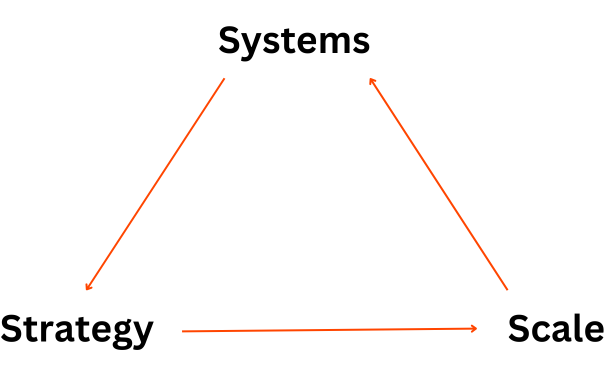
    Think of your business as a three-sided pyramid:

    The Solopreneur's Trinity

    Each element reinforces the others:

    • Systems enable strategy
    • Strategy directs scale
    • Scale demands systems

    Actionable Frameworks

    1. The 1/10/100 Rule

    Spend:

    • 1 hour planning
    • 10 hours building systems
    • 100 hours executing through those systems

    2. The Weekly Power Loop

    • Monday: Strategy Review
    • Tuesday-Thursday: Deep Work
    • Friday: Systems Optimization
    • Weekend: Reflection & Planning

    3. The 3R Method

    Every system must be:

    • Repeatable
    • Reliable
    • Refineable

    Common Pitfalls (And How to Avoid Them)

    Let’s face it:

    Building a solo business is like walking through a minefield.

    But don’t worry – I’ve got you covered.

    Here are the biggest pitfalls to watch out for:

    The Perfectionism Trap

    Ever spent 3 hours tweaking a single email?

    (Been there!)

    The Solution: Use the “80/20 Launch Rule” – when something is 80% perfect, ship it.

    The DIY Disease

    Trying to do everything yourself?

    Bad idea.

    Here’s why:

    • It leads to burnout
    • Kills your creativity
    • Limits your growth potential

    The Fix: Use “Value Hour Calculator” to decide what to outsource.

    Your 30-Day System-Building Challenge

    Week 1: Audit & Plan

    • Map current workflows
    • Identify automation opportunities
    • Set system goals

    Week 2: Build & Test

    • Implement one core system
    • Test with small tasks
    • Measure results

    Week 3: Optimize & Scale

    • Refine based on data
    • Add complementary systems
    • Increase automation

    Week 4: Analyze & Adjust

    • Measure impact
    • Calculate ROI
    • Plan next quarter

    A Final Thought

    Remember:

    The goal isn’t to work alone.

    The goal is to work intelligently.

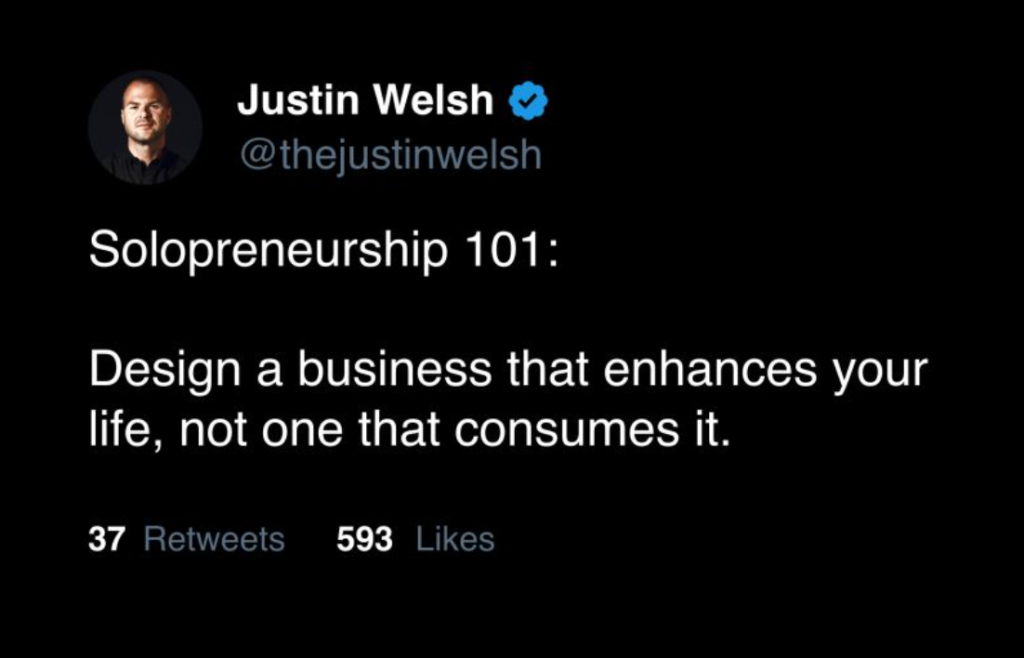
    Solopreneurship 101

    Build systems that work for you, not the other way around.

    Until Next Week,
    Think big | Start small | Keep going

Get 50 Actionable insights to

  • Supercharge your Marketing
  • Achieve 10X Productivity
  • Earn your first $1000 online
Bonus: You will get my free newsletter, delivered weekly.

No Spam. No fluff. Unsubscribe Anytime

50 Actionable insights

Unlock the secrets of top 1% digital entrepreneurs to achieve financial freedom.

yours free!

Bonus: You will get my free newsletter, delivered weekly.

No Spam, No Fluff. Unsubscribe Anytime

error: Protected content